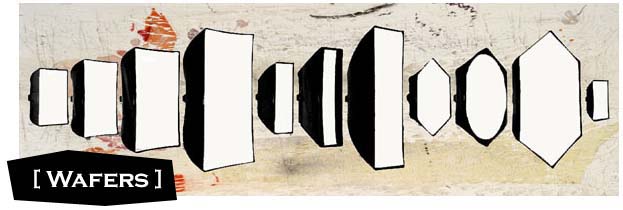
Lightbanks vs. Anything Else
Just as there are 108 flavors of ice cream, each with its following, there are more 108 different ways to illuminate your photographic subject - no right way or wrong ways - only your way.
But there are a couple of basic choices : Direct light - be it natural sunlight or artificial sources - tungsten, arc, fluorescent or flash - results in highly contrasted bright highlights and dark sharp shadows. While diffused light - either as a natural dawn or cloudy day or artificially diffused light created by reflecting a light source off of a large white surface or through a large translucent material - creates a more controlled highlight-to-shadow modulation which is the better choice to match the dynamic limits of film and digital technologies.
The usual choices by photographers of quick, reusable and transportable lighting and diffusion materials have in the been work with flash directed into white umbrellas or through large folding "flats". Both combinations do not easily create unobstructed highlights in critical highlight (think: wine bottles) nor keep bounced light from straying onto undesired areas and surfaces (think: green ceilings).
So, there are three reasons one might wish to consider a lightbank to diffuse the raw light from a flash. First, the clean unobstructed "reflexive" highlight reflected in the photographic subject. Second, the possibility of getting a broad diffused light source up close to your subject to create the lightbank's optimal broad modeling of light. Lastly, the improved control of the flash source because a lightbank's flat two dimensional diffuser and opaque reflective shell avoids light spill onto surrounding objects or flare back into the camera.
WAFER vs. any other lightbank
The three reasons to choose the WAFER Diffusion Bank to diffuse flash are its light quality, function and design. The WAFER quickly changes to meet the differences in lighting style and taste required by individual photographers and variations in specific subjects. Again, WAFER is created to match "your way", to be as flexible as possible to meet your unique and changing need and nuance.
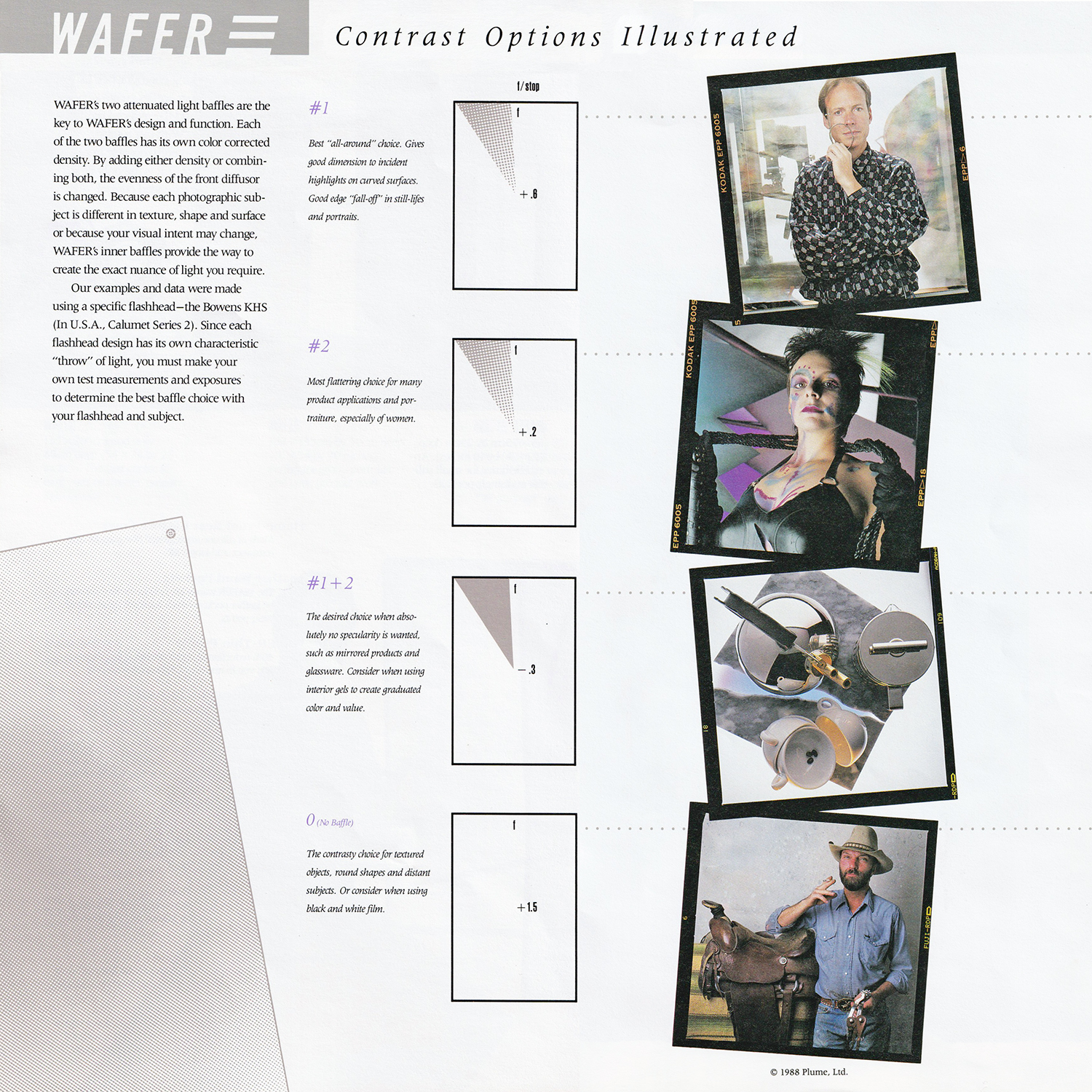
The WAFER's crisp but smooth quality of light places its performance and light quality apart from any other diffusion bank. The narrow profile, silver-with-white interior and unique graduated inner baffles create exceptional output efficiencies with a choice of light contrasts across the front diffuser. Each of the two inner baffles has an different attenuated pattern (US Patent 5023756) created using a halftone dot developed by using the photographic negative of the naturally occurring"hot spot", thus "negating" the expected center brightness and allowing four contrast choices across the front diffuser.
The lightweight WAFER works with most studio flash systems (see Dedicated Ring page). The rotating cast aluminum attachment ring is tensioned for precise placement of the WAFER and its reflexive highlight. The removable front fabric diffuser is easily exchanged with rigid frames of plastic diffusers or honeycomb grids for further specialization. Polarizers, colored filters and other diffusion materials can also be held by the rigid frames. for travel or storage.
The WAFER materials and construction have been carefully considered to provide the best function and value. Over 27 different premium materials have been sourced from Italy, the United Kingdom, Japan and the United States. Three different sailcloths are used for the Wafer diffuser, its baffles and the interior ellipses. A special aluminum fiberglass cloth around the flash head eliminates any heat and UV damage. The flattened WAFER profile results from using a combination of Easton aluminum tent tube with high tempered stainless steel rod or pre bent alloys. Special pole pockets reinforce the corners. Inner baffles, rear closures and ring adapters are all interchangeable between sizes. And all WAFERS are easily assembled for use and collapsed to fold with their attachment ring into a compact zippered bag for travel or storage - even the largest bag is not longer than 100 cm (40 inches).
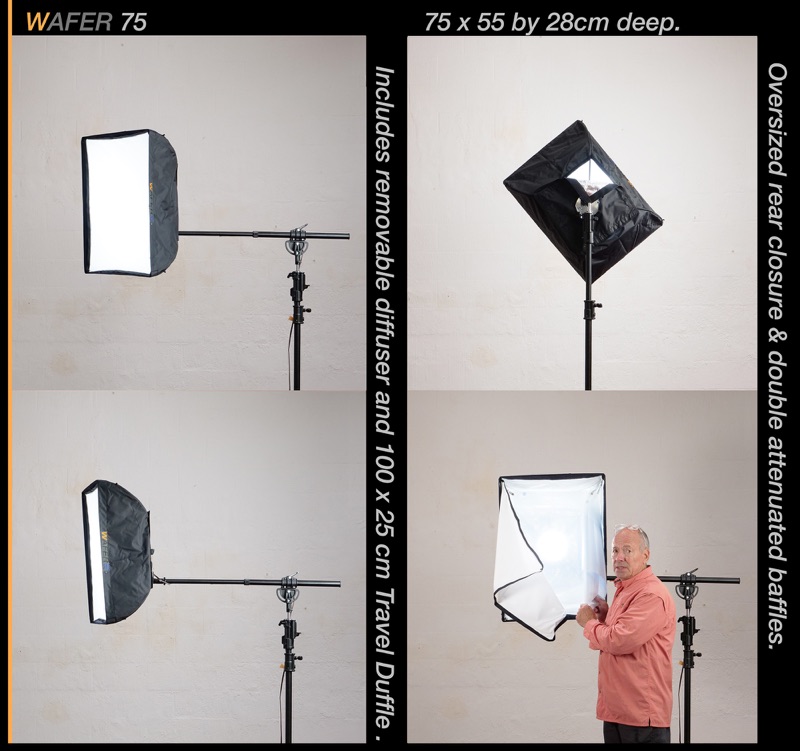
- WAFER75-AllFourTypeSM
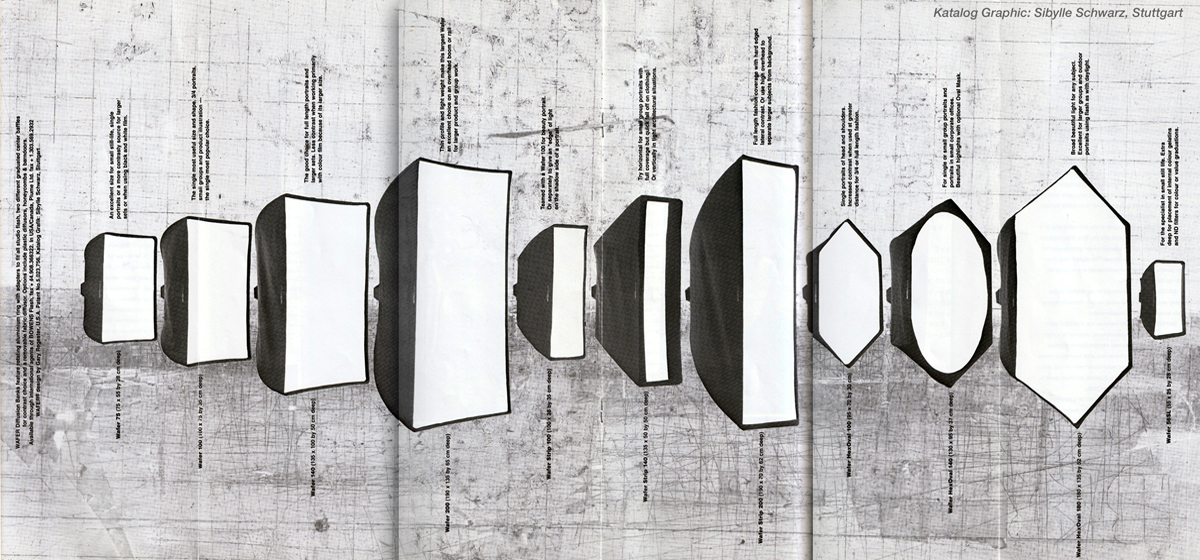
Wafer 75 (75 x 55 by 28cm deep - 29.5 x 21.5 by 11 inches deep). An excellent size for small still-life, single portraits or a more contrasty source for larger sets or when using black and white medium. $395
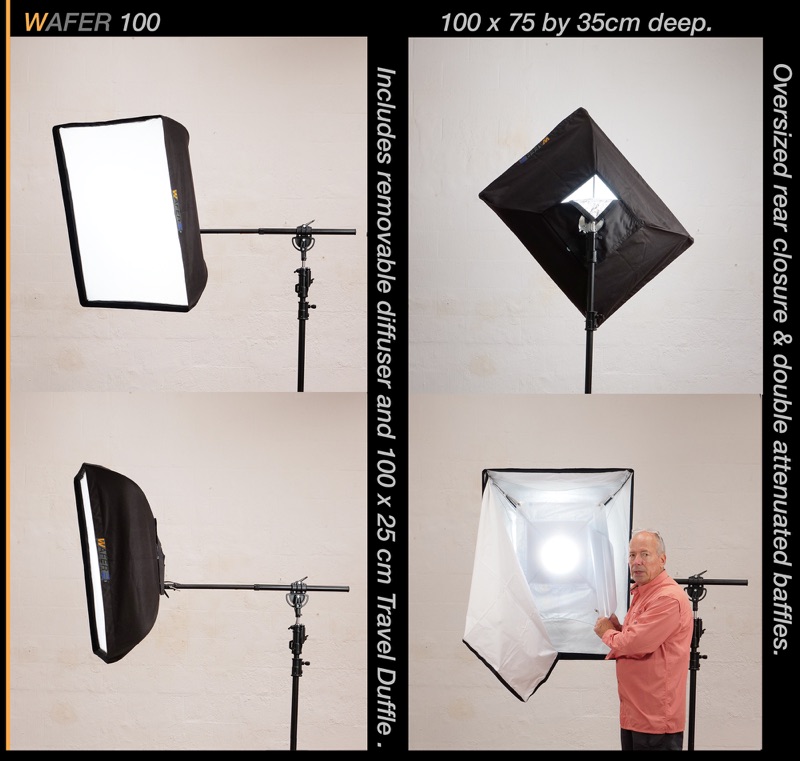
- WAFER100-AllFourTypeSM
Wafer 100 (100 x 75 by 35cm deep - 39.5 x 29.5 by 14 inches deep). The single most useful size and shape. 3/4 portraits, small groups and product illustration. Our most popular choice. $525
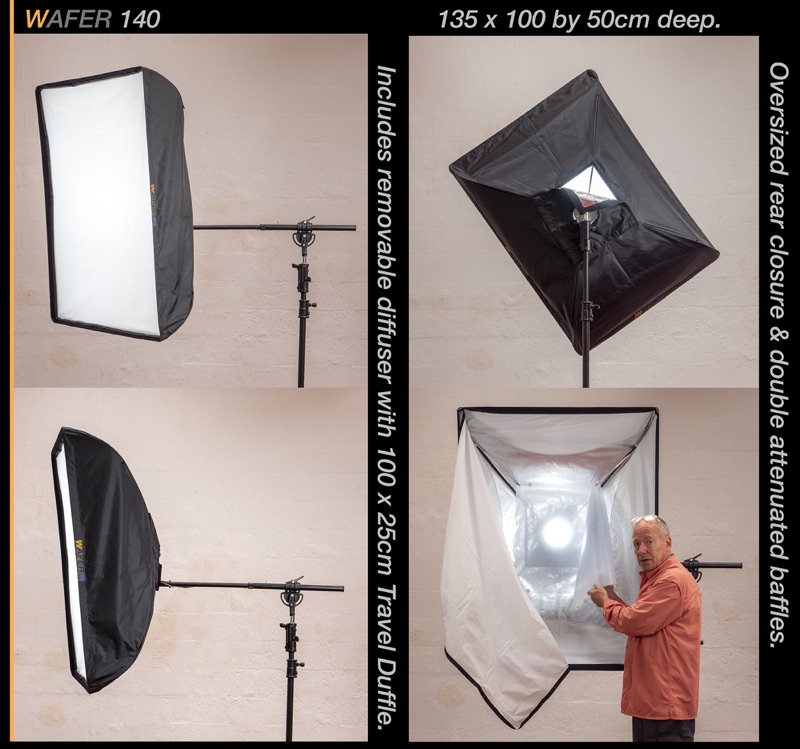
- WAFER140-AllFourType
Wafer 140 (135 x 100 by 50cm deep - 53 x 29.5 by 20 inches deep). The good choice for full length portraits and larger sets. Less contrast when working primarily with color medium because of its larger size. $650
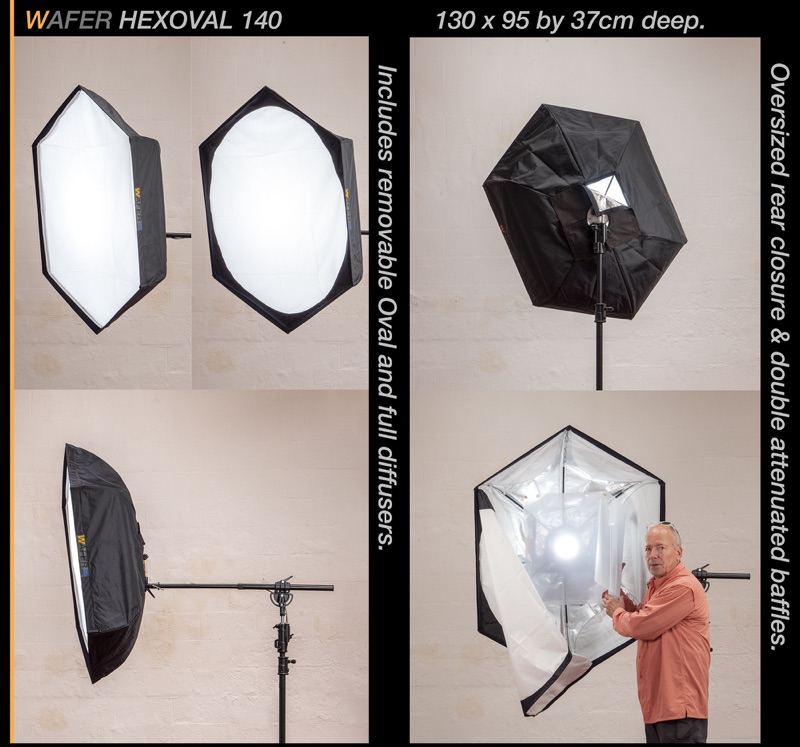
- WAFER140Hex-AllFourTypeSquareSMr
Wafer HexOval 140 (130 x 95 by 37 cm deep - 53 x 37 by 14.5 inches deep). The shape of the lightbank should match the shape of the subject. Our HexOval is ideal for "beauty" and portraits, single or more. $650
Wafer Models
Due to the recent demise of our very long time international licensee, Bowens International, in the UK, we have returned to our original Colorado fabrication using all Connecticut sailcloths. We have restored some of our original features as well - ripstop polyester black/silver fabric, an oversized rear closure cowl, exterior suspension loops and our oversized travel duffle - room for two Wafers or a Wafer with a lightstand. Our unique graduated inner baffles continues to be created by our original Ipswich UK silkscreen printing company.
Our limited production presently includes our three most popular sizes with the Wafer HexOval 140 coming next, shown here:
-
Wafer 75 (75 x 55 by 28cm deep - 29.5 x 21.5 by 11 inches deep). An excellent size for small still-life, single portraits or a more contrasty source for larger sets or when using black and white medium. $395
-
Wafer 100 (100 x 75 by 35cm deep - 39.5 x 29.5 by 14 inches deep). The single most useful size and shape. 3/4 portraits, small groups and product illustration. Our most popular choice. $525
-
Wafer 140 (135 x 100 by 50cm deep - 53 x 29.5 by 20 inches deep). The good choice for full length portraits and larger sets. Less contrast when working primarily with color medium because of its larger size. $650
-
Wafer HexOval 140 (130 x 95 by 37 cm deep - 53 x 37 by 14.5 inches deep). The shape of the lightbank should match the shape of the subject. Our HexOval is ideal for "beauty" and portraits, single or more. $650 Why an Oval ?
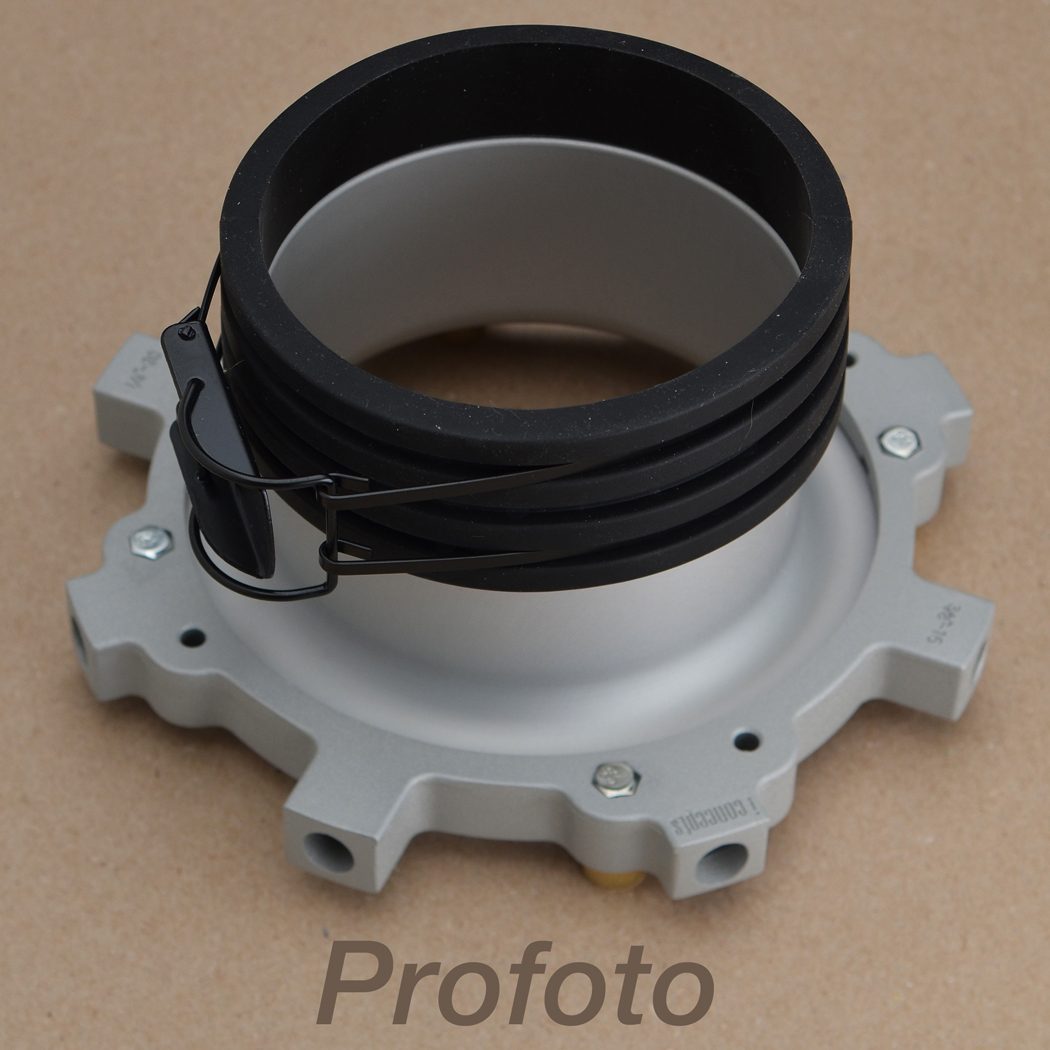
Flash Rings
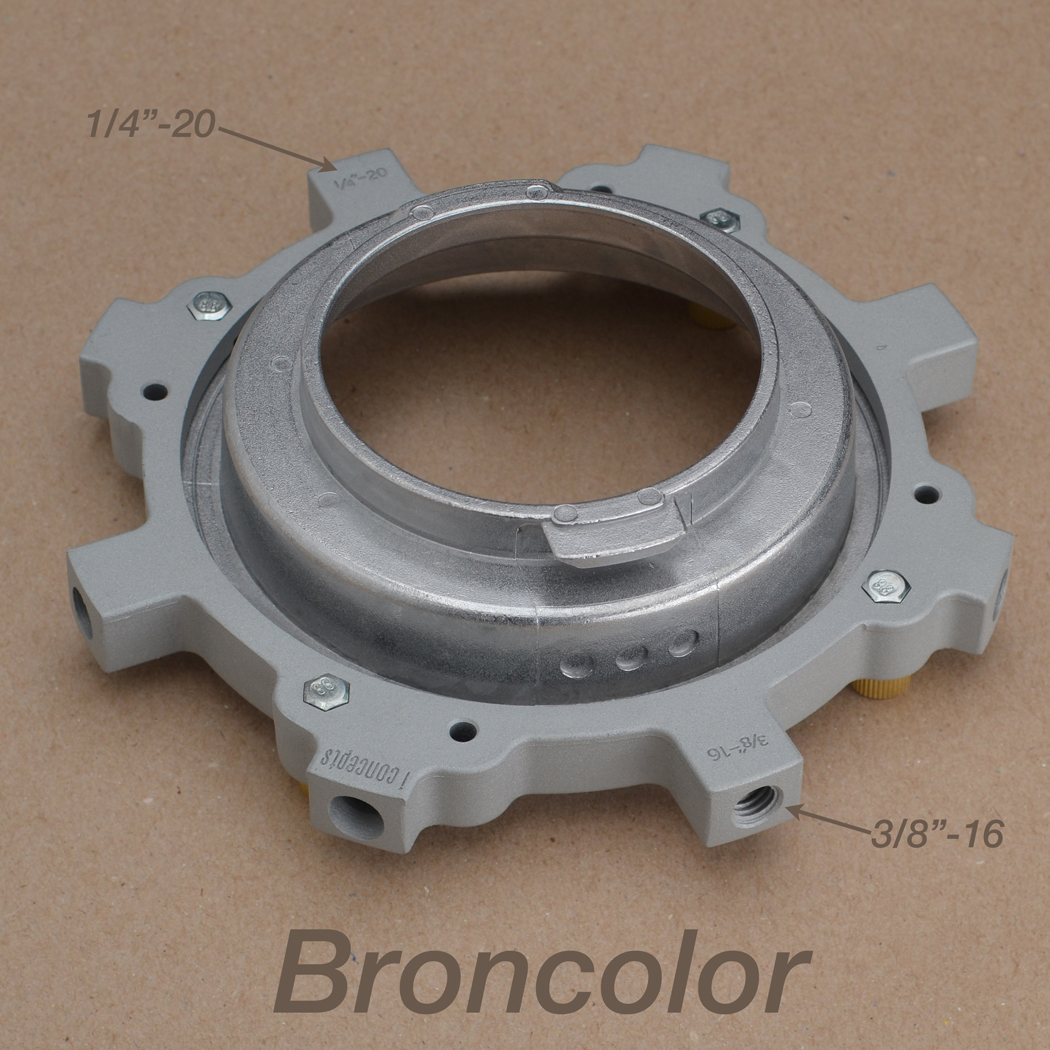
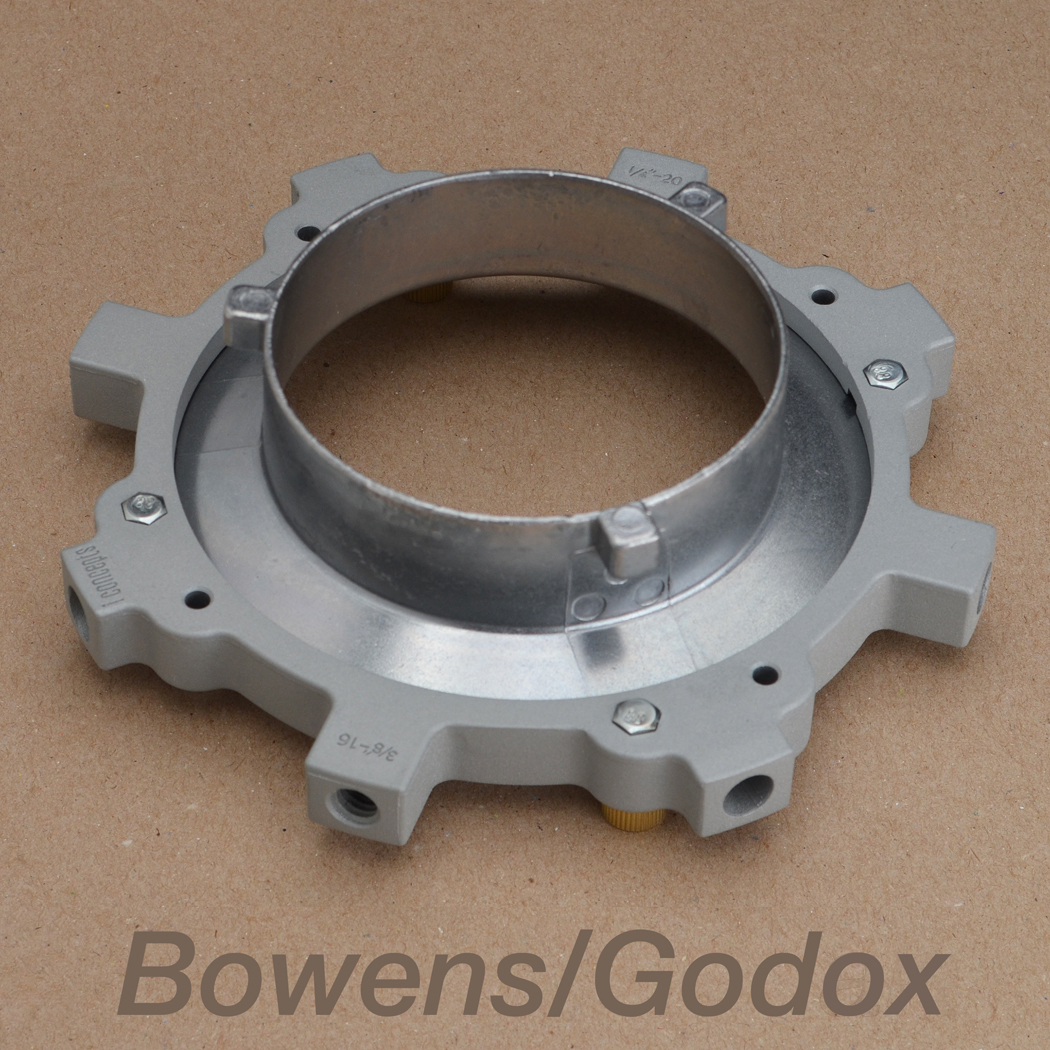
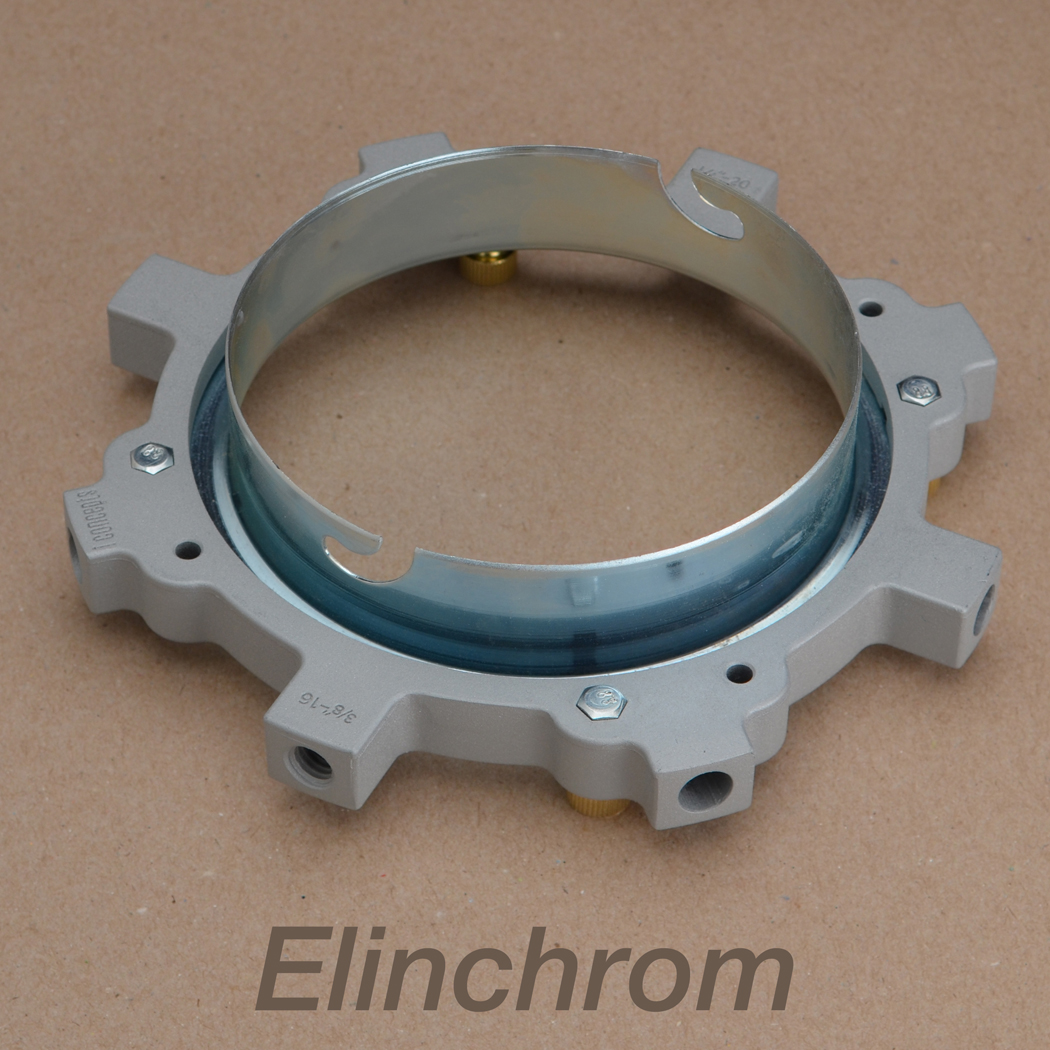
Overview of Features: The new aluminum Plume Flash Ring is designed as an improved "universal" attachment for WAFER and most of our competition's light diffusion banks and soft boxes including Chimera, Photoflex, Calumet, Redwing, Bowens and Westcott offerings. The improvements are thinner profile, lighter weight and extra placements for ring based accessories. Our design not only provides the structural basis to these banks, but it also allows easily finger controlled tensioned rotation and quick change of inner adapters to a variety of manufacturers' flash head by means of various adapter rings. If we do not happen to produce a specific adapter, please inquire.
Description: The Plume Flash Ring consists of an outer ring, which will support the diffusion bank, and an inner flash head adapter ring, which mounts to your particular brand of flash "head" or housing. The outer ring and inner adapter ring are easily assembled and, generally, attach in the same way as your reflectors attach. (see specific notes below).
The outer ring features four primary (unthreaded) holes into which the lightbank's poles (or wands) are inserted. These four holes are located adjacent to the four brass thumb nuts. Note that one of these four holes is marked with the word "I Concepts". This marked hole has a special tension release notch at a lesser angle than the other holes, making assembly and disassembly easier. Use this notched hole LAST during assembly, and FIRST in disassembly. (Note two other unthreaded holes are available for supporting the six wands of the HexOval WAFERS. Use one of these holes as the LAST (assembly) or FIRST (disassembly) with the HexOval models.)
Two threaded holes (1/4-20 and 3/8-16) are also provided on the outer ring for direct attachment to light stand adapters, attachment of interior flags or scrims or for mounting second and third flash heads to the lightbank.
The outer ring rotate on the inner adapter ring. Adjust the ease of this rotation by changing the tension on one or all of the thumb nuts.
The inner adapter ring can be easily removed and exchanged with a different inner adapter ring specific to another brand of flash equipment
Please note that although our rings are universal, other manufacturers rings may not work on Plume Wafers.
Wafer Assembly Instructions
Take a look or print the Wafer Price List and fill in an email with your order, questions or comments.
All pricing
is in US Dollars. We accept payment by AMEX, Visa or Master Card.
Pricing
includes UPS Ground shipment or USPS Priority Mail International .
On Ordering:
Plume happily ships our dealer orders directly to you from Colorado or you may order directly from Plume.
- USA B&H link: https://www.bhphotovideo.com/
- Fotocare link: https://www.fotocare.com/Default.asp
- Samy's link: https://www.samys.com/
- Europe/UK Nivo Schweitzer link: https://www.nivo-schweitzer.nl/
- Asia/Japan HiroCo link: http://hiro.company/
News:
NEW Plume Wafer HexOval 140 Now Available Priced at $650
About Plume: Our History & Warranty
About Gary Regester: Specialty lighting designer, photographer, inventor, etc.
YouTube: Wafer Explained and Wafer 200 Explained
Plume 30th Anniversary Trade-In / Trade-Up Offer: If you are an original WAFER owner and want a new or larger WAFER, here is an opportunity...read more...►